When you click the link, it will take you to the corresponding page.
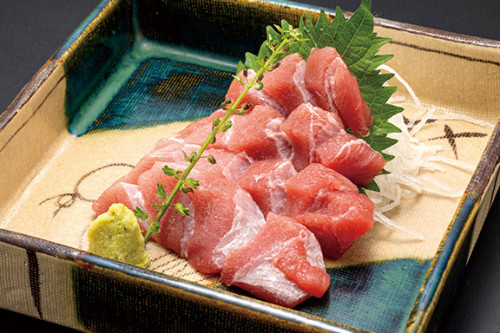
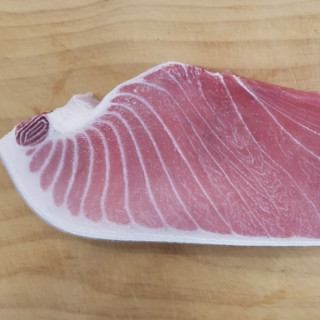
天然本マグロ大とろ刺身(4切)
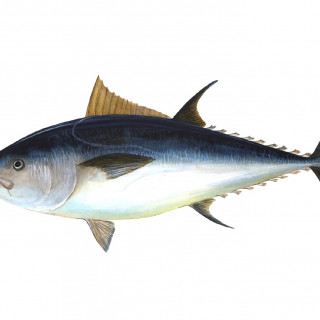
A large tuna distributed in the tropical and temperate waters of the Pacific Ocean, including the coasts of Japan. The standard name in Japanese is "Kuromaguro" (黒鮪), but it is generally distributed under the name "Honmaguro" (本鮪). Typically, when fully grown, it can reach 3 meters in length and weigh up to 300 kilograms. Among tunas, the bluefin tuna is the largest and most expensive high-grade species, with prices reaching tens of millions of yen per fish. In Japan, bluefin tuna caught using the "Ipponzuri" (一本釣り, single-hook fishing) method is considered the highest quality. There are several theories about the origin of the name "maguro" (tuna). One theory is that it is called "maguro" (眼黒) because of its black eyes. Another theory is that because its back is black, it looks like a small black mountain from the ship, hence "maguro" (真黒). Another theory is that it turns black when left at room temperature, hence the name maguro.
The parts of tuna can be broadly divided into two categories: the fatty part called "toro" and the lean part called "akami" (red meat). Toro itself can be divided into several parts, but the most representative are "otoro" (大トロ), which is the fattiest part, and "chutoro" (中トロ), which has a balance of akami and fat. Generally, otoro refers to the fatty belly meat near the head of the tuna, while chutoro refers to the meat found in the belly and back areas of the tuna. However, there are no strict rules that clearly define the difference between otoro and chutoro. Recently, toro has become a popular sushi topping, often costing more than twice the price of akami. However, in the past, Japanese people ate only the akami part of the tuna, and toro was considered a discard. The Japanese in the old days preferred a clean taste over a fatty one, and due to the lack of refrigeration and distribution technology, the fatty toro parts would spoil quickly. In the Edo period, it was even referred to as "nekomatagi" (猫またぎ), meaning something even cats would pass over. As Japanese tastes evolved and refrigeration technology developed, toro gradually gained its current popularity. The name "toro" is derived from the Japanese word "torokeru" (とろける), which means "to melt." It was first called toro in 1918 by the long-established sushi restaurant Yoshinozushi (吉野鮨) in Tokyo, and this name spread and became widely used. Before that, the fatty part was called "abu" (アブ), derived from "abura" (脂), meaning fat.